
Every buyer I meet at the Canton Fair asks the same two questions: “Will the customer actually see my product?” and “Can I get a custom clear folding box without waiting six weeks?” The answer to both is the same box — a clear folding box from our factory in Guangzhou. Transparent packaging does one job better than anything else in the industry: it lets the product sell itself. This guide walks through what a clear folding box really is, the materials we run, the eighteen industries we pack every day, and how to order yours without the usual headaches.
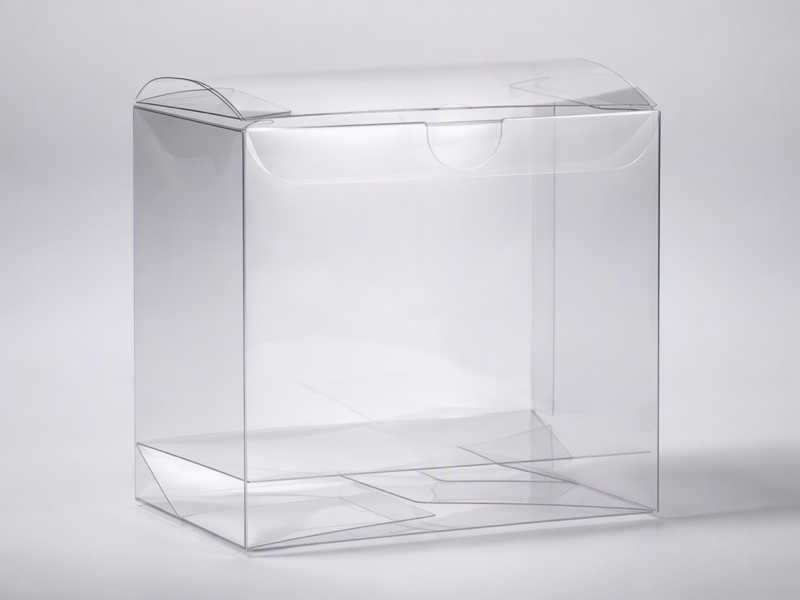
What Is a Clear Folding Box?
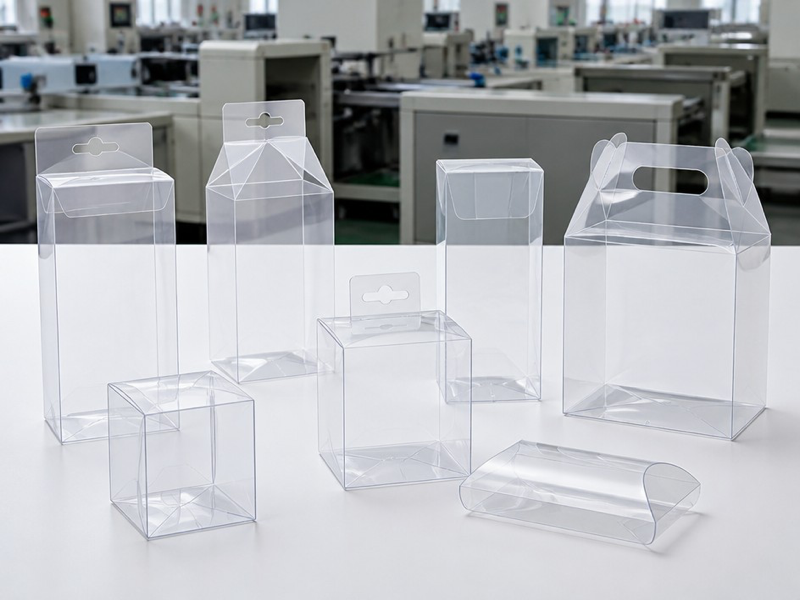
A clear folding box is a transparent container that ships flat and pops open in seconds. Made from PET, PVC or acetate sheet, it gives your product 360-degree visibility while keeping the structural rigidity of a folding carton. Because it ships flat, freight volume drops by up to 70% compared with rigid boxes — the same advantage our folding gift box customers have relied on for years. If you are asking “what is a clear folding box” and whether it suits your product, the short answer is: it suits almost anything that benefits from being seen.
Materials We Actually Run on Our Lines
Material choice decides both the look and the cost of your clear folding box. PET is our workhorse — food-safe, recyclable, and crystal clear, which is why we recommend it for food and cosmetics. PVC remains the budget favourite for retail and hardware, with strong clarity and easy thermoforming. Acetate gives the premium feel that cosmetics and perfume brands want, with a slightly warmer tint and excellent printability. For buyers asking about a transparent folding box manufacturer who can handle all three, we run them side by side on the same tooling files, so your repeat orders stay identical batch after batch.
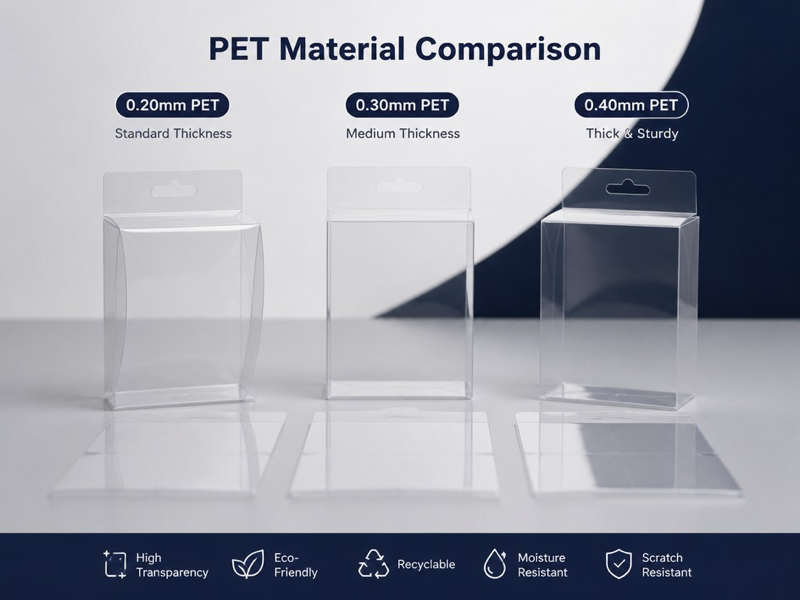
Clear Folding Box Sheet Gauge, Crease Depth and Hang-Load Limits
Most quotes I see from other suppliers give you a material and a price and stop there. The three numbers that actually decide whether a clear folding box survives the courier — and survives the shop assistant — are sheet gauge, crease depth and hang-tab load. These are the settings we run on our own lines, written down so you can ask any supplier the same questions.
Gauge by Product Weight: What We Actually Run
0.3mm PET or PVC covers small, light goods — lip gloss, single sachets, trading cards, hair ties — up to roughly 80g of packed weight. 0.4mm is our default for cosmetics, earbuds, pens and craft kits up to about 250g: it creases cleanly by hand and still holds a printed card behind the product without bowing. 0.5mm takes 250-600g — multi-pack socks, cutlery sets, hardware kits — and it is the thinnest sheet I would hang on a peg above 300g. 0.6mm is for 600g to 1.2kg, or for any box longer than 250mm where the span is doing the work, and it is the gauge where crease quality stops being automatic. 0.8mm exists for heavy or sharp contents, and at that point I usually argue for a tray insert or a different format instead of a heavier sheet, because an 0.8mm fold is stiff enough that packers fight it all shift and the line slows down.
The mistake I see most often is buying gauge for the product and forgetting the packing bench. A 0.4mm box with a paper insert packs in six seconds; the same box in 0.6mm takes ten, and across fifty thousand pieces that gap is a real labour line. If your annual volume is above 20,000 pieces, say so at quoting stage and we will run the fold test before recommending a gauge.
Why the Crease Line Whitens — and What We Change in the Die
Whitening along a fold is not a material defect, it is a die problem. Clear sheet is stressed when the crease line crushes the polymer instead of drawing it, and the white line is that stress showing up under light. On our lines the fix is always the same three dials: crease depth, land width and radius.
As a starting point we set crease depth at roughly 0.12-0.15mm for 0.4mm sheet and 0.18-0.22mm for 0.6mm, with a land of 0.6-0.8mm and a radius no sharper than 0.3mm. Too shallow and the box will not fold square — it springs back, the packer forces it, and the line cracks by hand. Too deep and the sheet is cut most of the way through, so the box tears open on the second open or fails in transit. The right setting is the one where fifty boxes fold flat, stay flat and show no white line at the fold, which is the knock test we run on the first bundle of every batch. It takes two minutes and it is the cheapest quality gate in the plant.
Two things move the setting. Temperature: below about 12°C clear sheet stiffens, and a crease that is perfect in July will crack in a December warehouse or an unheated container — which is why we hold bundles indoors for twelve hours before winter packing, and why we ask where the pack is being filled, not just where it is being shipped. Material: PVC creases at a lower depth than PET and whitens more visibly when it is over-crushed, while acetate is the most forgiving on the fold and the least forgiving on humidity. Our PVC vs PET vs PP material comparison sets the three sheets side by side, the acetate versus PET note covers the premium end, and the die-cut and creasing walkthrough shows what a real crease line looks like on a dieline.
Hang Tabs, Euro Slots and Hang-Load Limits
Peg display is where a lightweight box earns or loses its retail listing. A single euro slot punched in 0.4mm sheet carries about 1.5kg safely; a reinforced tab with a 12mm land carries around 3kg; and a double tab is what I recommend above 3kg or for anything longer than 200mm, because the load that bends a hanger over a season is not the weight on day one. The failure we see in returns is rarely the tab tearing out — it is the sheet bowing under the tab until the box tips forward and creases across the front face.
Three practical notes. Put the slot in the centre of the top panel and at least 12mm back from the crease, or the fold ends up carrying the load. Keep the top panel under 120mm wide for peg work, since wider boxes hang crooked whatever the gauge. And if the retailer specifies a shelf-ready hook, send us their fixture drawing: a thirty-second check against our existing tooling saves a whole run, and mismatch here is the most common reason a first shipment gets refused at the DC. The two shapes most buyers end up choosing are a PET rectangular clear box with a hanger hole for flat goods and a hanging hole box for eyelash packaging for the small, light SKUs that live on a cosmetics peg.
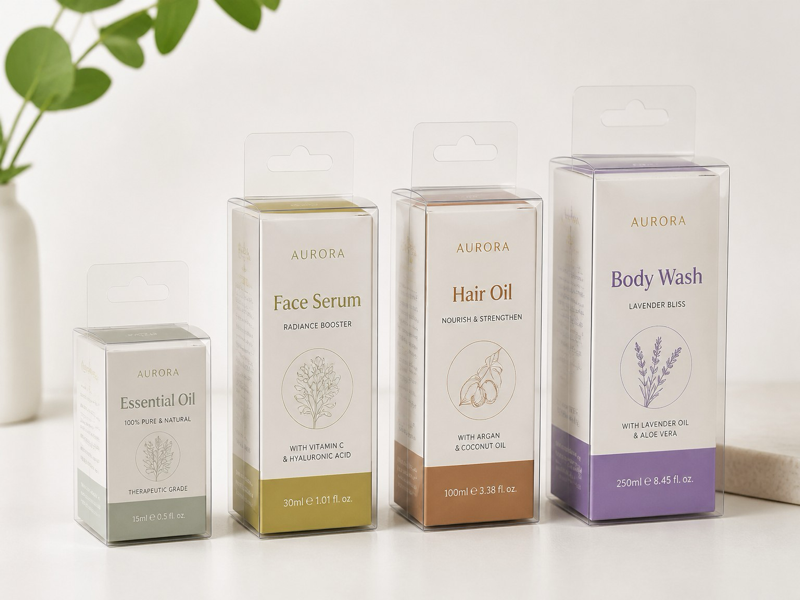
18 Industries We Pack in Clear Folding Boxes
Over the years our clear box for cosmetics line has grown into eighteen industry clusters. The list below is not marketing copy — it is the actual production split we see in our order book, and each cluster covers several SKU families, which adds up to well over sixty product types in a normal month.
Beauty and Personal Care
A clear box for cosmetics, clear box for lipstick, clear box for makeup brushes, clear box for eyelashes, clear box for perfume and clear box for skincare products. Cosmetic brands choose clear packaging because shelf testing consistently shows that visible product lifts purchase intent.
Food and Confectionery
A clear box for chocolate, clear box for candy, clear box for cookies and clear box for dried fruit. Food-grade PET keeps contents visible and protected, and our fruit container customers often pair the box with a thermoformed tray insert.
Baby and Mother Care
A clear box for baby bottles, clear box for baby toys and clear box for pacifiers. Parents trust packaging they can inspect, and the foldable format keeps your warehouse footprint small.
Electronics and Accessories
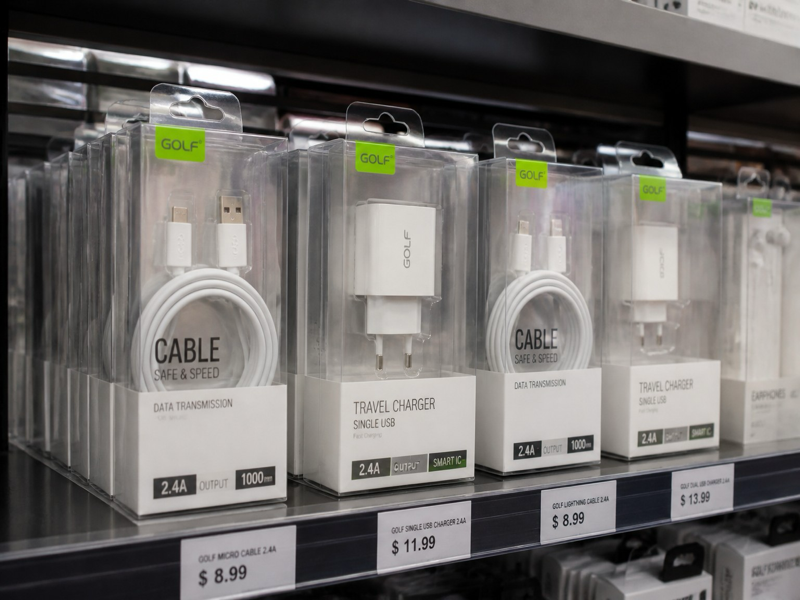
A clear box for earbuds, clear box for cables, clear box for smartwatch bands and clear box for USB drives. Anti-static PET is available for sensitive components, and the hang hole option turns the box into a retail-ready display unit.
Toys, Collectibles and Gifts
A clear box for action figures, clear box for trading cards and clear box for jewelry. Collectors want to see the item without opening the seal — a clear folding box with a tamper-evident closure gives them exactly that.
Jewelry and Watches
A clear box for rings, clear box for earrings, clear box for bracelets and clear box for watches. Jewelry buyers are the most packaging-sensitive group we deal with: they need the piece visible, the insert flocked, and the box small enough to sit inside a gift bag. Most of these runs use a flocked or EVA insert inside a clear folding box so the piece stays put during courier handling, while the printed paper sleeve carries the brand story without stealing attention from the product.
Pet Care
A clear box for pet treats, clear box for pet toys, clear box for grooming tools and clear box for dog accessories. Pet brands choose transparent folding boxes because buyers want to see the treat before they trust it, and the flat-pack format keeps retail shelf restocking simple.
Stationery, Art and Office
A clear box for pens, clear box for art supplies, clear box for stationery sets and clear box for craft kits. These SKUs sell well on the peg hook — the printed paper sleeve does the branding work while the box keeps the contents visible.
Craft and Hobby
A clear box for beads, clear box for sewing kits, clear box for model kits and clear box for DIY craft sets. Craft buyers restock in small, frequent orders, which is exactly what a clear folding box is good at: low tooling cost, flat shipping, and a compartment layout you can change between sizes without rebuilding the whole box. If you are weighing a clear box with insert against a plain sleeve, the craft category is where the insert almost always wins — loose beads and small parts need dividers.
Hardware, Tools and Automotive
A clear box for hardware parts, clear box for drill bits, clear box for small tools and clear box for automotive parts. Hardware buyers value fast picking: a clear folding box with a hang hole lets the warehouse identify contents at a glance and keeps small parts from getting lost on the shelf.
Health, Medical and Wellness
A clear box for medical devices, clear box for supplements, clear box for health products and clear box for first aid kits. Medical-grade PET is available where certification matters, and tamper-evident closures are standard tooling for these runs.
Kitchen, Household and Cleaning
A clear box for kitchen gadgets, clear box for cutlery sets, clear box for cleaning tablets and clear box for sponges. Household buyers usually come to us after a rigid box quote comes back too expensive: a clear folding box holds the same six-piece set, ships flat, and costs a fraction of the freight. Where the set has sharp metal parts, we add a PET tray insert so nothing punctures the sheet in transit.
Candles, Soap and Home Fragrance
A clear box for candles, clear box for soap bars, clear box for wax melts and clear box for reed diffusers. Candle makers care about clarity more than anyone — the whole purchase decision is the look of the wax and the label. We run these in acetate for the premium tinted look, or PET when the buyer wants maximum transparency, and the box is normally finished with a low-ink paper sleeve so the wax colour reads true through the sheet.
Apparel and Textiles
A clear box for socks, clear box for hair accessories, clear box for scarves and clear box for gift sets. Textile SKUs are usually packed as multi-packs, so the box dimensions are driven by the folded stack rather than a single item. This is the one category where we spend most of the sampling time on folding geometry — get the fold right once and every repeat order packs itself.
Sports, Outdoor and Events
A clear box for fishing lures, clear box for outdoor gear, clear box for party favors and clear box for event gifts. Seasonal buyers like this format because the tooling stays on our floor year-round — order in February, restock in October, same box, same print.
Floral, Garden and Nursery
A clear box for roses, a clear box for bouquet wraps and a clear box for seed sets are the three orders we see most from florists and garden centres. Flowers arrive in bulk, so the pack has to be assembled at the counter in seconds — a tuck-end clear folding box folds flat and takes a printed card behind the blooms without hiding them. For seed and bulb kits we add a die-cut divider so packets and labels stay upright on a garden-centre shelf, and we spec a heavier gauge because a watering can is never far away. Nurseries also order clear boxes for potted orchids and gift arrangements where the customer wants to see the moss and root ball before buying. If the pack is going onto a damp shelf or into a cool room, say so at quoting stage and we will move you off a standard sheet onto a thicker one.
Optical, Eyewear and Sunglasses
Optical shops and sunglass brands order a clear box for glasses frames, a clear box for reading glasses, and clear boxes for lens kits and cleaning sets. Clear works here because frames are a look rather than a utility — a buyer wants to see the colour and the shape before an assistant opens anything, and a transparent box lets the shop keep stock on open display without a locked cabinet. We add a shallow tray insert so the frame cannot slide, and because acetate frames are sensitive to heat we recommend storing this pack away from a south-facing window instead of relying on the box for sun protection. For prescription work we leave a printable label panel on the base for the batch reference, and for sunglasses sold online the flat-shipping format keeps postal volume at a fraction of a rigid case.
Music, Audio and Instruments
Music shops and audio brands order a clear box for earphones, a clear box for guitar strings, a clear box for picks, capos and small accessories, and clear boxes for studio add-ons. A counter pack has to do two jobs at once: keep tiny items countable, and let the customer pick a gauge or a size without opening anything. A clear folding box with a printed gauge card behind the product solves both, and it hangs from a peg with a single hang hole. For string sets we usually add a shallow tray so the coil stays flat, and for earphones we keep the cable cavity open so the pack can be closed again after a demo. Instrument accessories are small, low-value lines, so the honest advice is to keep the pack simple and let flat shipment carry the cost saving.
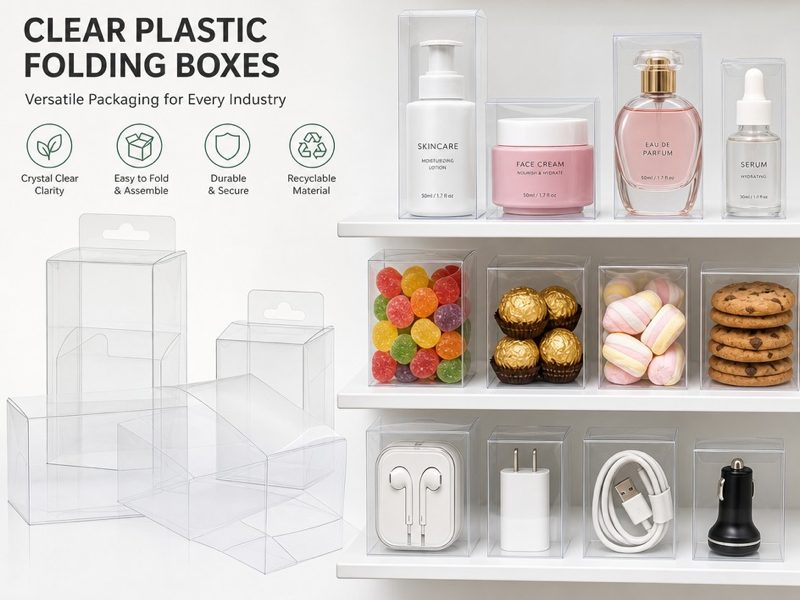
That is eighteen industry clusters, and the pattern behind every one of them is the same: if the product looks good, let it be seen.
Clear Folding Box Variants We Quote Every Week: The Long Tail Behind the 18 Industries
Eighteen clusters is the map; the orders are the streets. What actually lands in our inbox is a variant — one product, one count, one shelf — and the variant is where the specification gets decided. These are the requests we quote most weeks, with the detail that usually makes or breaks each one.
Beauty and nail sub-variants. A clear box for press-on nails with a euro slot and a printed size card behind the tips; a clear box for lip gloss with a shallow tray so the tubes cannot roll; a clear box for eyeshadow palettes with a flocked insert; a clear box for sheet masks sold as a five-pack, where the paper sleeve carries the expiry date because the sheet itself cannot. Nail and lash lines are the ones that reach us after a blister quote — same visibility, a fraction of the freight, and the box can be reopened for a counter demo. A printed clear folding box for false eyelashes is the version most of that market settles on.
Food and confectionery sub-variants. A clear box for chocolate bars with an inner tray that still holds shape in a 30°C warehouse; a clear box for macarons packed in sixes and twelves; a clear box for dried fruit and nuts where the window is the entire point of the pack; a clear box for tea sachets with a printed back card so the brewing note reads without opening the lid. Food is where gauge and closure matter most: a tuck end that springs open in a chilled cabinet ends that listing, and a printed folding box for dried fruits and nuts is the format we build most often for the ambient shelf.
Electronics and hobby sub-variants. A clear box for charging cables with a cable-shaped cavity; a clear box for trading cards in a gauge stiff enough that corners cannot bend; a clear box for building blocks with a divider so the piece count is visible; a clear box for model kits where the sprue sits on a printed card. Hobby buyers reorder small and often, so the flat-pack advantage compounds across the year, and a printed folding box for trading cards covers most of the collectible side.
Seasonal and event sub-variants. A clear box for wedding favours in twos and fours; a clear box for advent calendar inserts; a clear box for party favours with a printed label panel; a clear box for gift sets where the sleeve changes by season and the box does not. This is the group where one dieline earns its keep for years — same tooling, four sleeves a year, no new sampling.
If your product is not on this list that is usually a good sign rather than a bad one: it means the dieline should be built around your item instead of ours. Send the dimensions, the packed weight and a photo of the shelf it will sit on, and we will come back with a structure, a gauge and a price within one working day. The clear folding boxes category above shows the shapes already running, and the quote form is one click from every page.
Custom Options: Inserts, Printing and Hangers
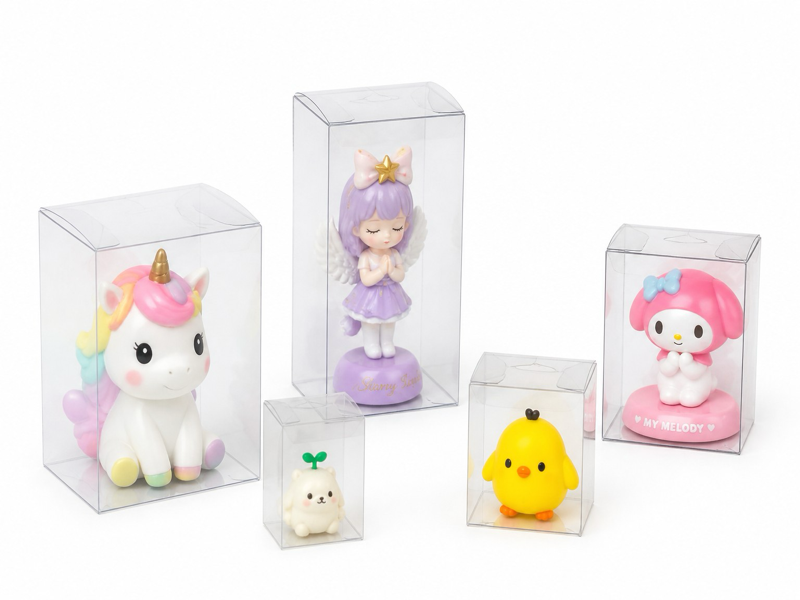
A clear folding box is rarely shipped as a plain sleeve. Most of our orders combine the box with a blister tray insert to hold the product in place, printed paper sleeves for branding, and a hang hole for retail hooks. If your product needs extra structure, ask about a clear box with insert or a clear box with blister tray — both are standard tooling on our floor, and our blister tray inserts are formed on the same site as the boxes so the fit is guaranteed. For display-driven SKUs, a clear folding box with hang hole keeps the product upright on the peg and stops it from spinning around, which retailers notice and appreciate.
Printing on a clear box is the job buyers underestimate most. Sheet takes ink differently from board, so a full-bleed logo printed straight onto PVC reads muddy and scratches in transit; the clean route is a printed paper sleeve or a reverse-printed card behind the product, which keeps the sheet clear and the branding readable. We quote both routes side by side, and our write-up on printing options for clear foldable packaging sets out screen print, hot stamping and the sleeve route with the real cost difference between them.
Clear Folding Boxes on the Packing Line: Assembly Time, Carton Counts and Freight Savings
A clear folding box only starts earning its keep when it reaches a packing bench. It arrives flat in bundles of 100 or 200, and the tuck flap is the only part that moves. A plain tuck-end box takes a trained packer six to ten seconds to crease, pop open and fill. An auto-lock bottom with a tray insert takes twelve to fifteen, because the tray has to seat before the product goes in. A semi-automatic line with a carton erector will run 25-40 a minute, but an erector only pays for itself on an auto-lock bottom in one fixed size — change the size every season and the machine turns into the bottleneck.
What actually stops a run is fold memory, not clarity. A 0.4mm PVC sheet creases cleanly by hand. At 0.6mm the same fold whitens along the score unless the dieline carries a real crease line, and on a cold morning the sheet cracks instead of folding. We hold bundles indoors for twelve hours before packing in winter, then knock test fifty boxes from the first bundle: if the fold line shows stress marks, the crease depth is wrong, not the sheet. The gauge range we run is listed on our PVC, PET and PP transparent packaging boxes page, and the crease setting changes with every thickness.
Freight is where the format wins. A thousand assembled rigid boxes on a 100 x 150 x 40mm footprint take about a cubic metre of container space before you allow for pallet voids. The same thousand clear folding boxes ship in roughly a tenth of that volume, in cartons one person can lift. The sheet is cheap; the air inside a made-up box is not. We keep finished stock flat in the Guangzhou warehouse and release bundles against your packing schedule, so you are not paying to store air either.
Retail-ready packs add a sequence, and getting it wrong is the most common rework we see. The printed card goes behind the product first, then the box closes, then it hangs — insert the card after closing and the box distorts at the fold. Multi-pack SKUs follow the stack, not the item: a folded pair of socks or a hair accessories gift set is measured as a bundle, and the dieline is built around that bundle. Our clear folding box for earbuds is the same logic at a smaller scale, and the retail display formats we build all share that card-first order.
There is a point where labour costs more than the freight saving. Under 500 pieces a month, hand-folding an auto-lock bottom is slower than taping a rigid box, and for products above 1.5kg the gauge has to jump and the fold gets awkward in the hand. Small craft sizes behave differently again — thin sheet, high piece counts, frequent restocks — which is why the small clear folding boxes we quote for craft buyers are usually tuck-end. If your volume sits in that band, we will say so rather than sell you a heavier specification.
The honest test takes an afternoon. Ask for a sample in your sheet, time one packer on fifty boxes, and multiply by your labour rate. Add the freight you save by shipping flat and compare the two numbers against a rigid box. That is the figure that decides the format — not the unit price on a quotation. Our standard folding format is shown on the custom folding clear gift box page, and if you send dimensions with a monthly volume we will come back with the same calculation for your product within one working day.
How to Choose a Clear Folding Box Supplier
If you are searching for “how to choose clear folding box” options, focus on four things: material certifications, tooling ownership, sample speed and lead time honesty. A clear folding box supplier who owns the moulds will quote faster and hold prices longer. Ask for samples before committing — we ship samples within 3-5 days, and we expect serious buyers to test fit and clarity before the production run. Where to buy clear folding boxes is a common question; the answer that matters is to buy from a manufacturer who can also handle your tray, sleeve and carton needs under one roof, so quality responsibility never gets split between vendors.
Two questions come up in almost every enquiry, so we wrote them up separately: where to buy clear folding boxes without paying a trader’s margin, and how to assemble clear plastic folding cartons so the first carton of a shift does not slow the whole line. If you are weighing this format against a rigid presentation box for the same product, our note on clear folding boxes versus rigid clear boxes is the shortest read we have on it.
Ordering, MOQ and Lead Time
Our standard MOQ for clear folding boxes is 3,000 pieces, and first production runs typically ship in 10-15 days after sample approval. Repeat orders move faster because the tooling is already on the machine. We hold finished stock in our 2,000 m² climate-managed warehouse for regular customers, releasing batches on demand to match your packing schedule. Every batch is checked against your approved sample — cavity dimensions, sheet thickness and forming temperature are recorded, so the thousandth box matches the first.
Why Buyers Choose Clear Folding Boxes Over Other Formats
Every format has a job. After years of running folding and thermoforming lines side by side, this is where clear folding boxes win and where they do not.
Clear folding boxes beat printed paper cartons on proof. A carton has to promise what is inside; a transparent box shows it. For cosmetics, craft kits, collectibles and small electronics the product is the argument, and printed board hides every bit of it. Where a brand still needs copy, the printing goes on a paper sleeve or an insert card behind the product, so the pack carries both the artwork and the actual item.
They beat clamshell blisters on freight and on opening. A clamshell is formed to shape and ships bulky, and it usually has to be cut open. A clear folding box ships flat and folds in seconds, which cuts freight volume to a fraction, and it can be opened and closed again — the difference between a pack that is destroyed in the shop and one that goes home with the customer. Our clamshell blister packaging guide covers the categories where a blister is still the right answer.
They beat poly bags and shrink wrap on structure and shelf presence. A bag has no shape, no print panel and no insert capacity, and shrink wrap says nothing about the product until it is unwrapped. A clear folding box holds its shape, holds a tray, and stands on a shelf without a support.
And where clear folding boxes lose. For a heavy or fragile item, a rigid box with a foam cavity takes impact better. For anything that must stay sterile or completely sealed, a barrier pack is the honest answer. For a cylindrical product — a balm, a bottle, a candle — a tube keeps the shape better than any flat pack, and our clear cylinder boxes guide covers that family. For a very low unit price at high volume a plain bag can still be cheaper. A supplier who tells you that before you commit to tooling is the one worth keeping; the sheet decision itself is worth an hour of reading, and our guide to clear folding box materials walks through PET, PVC and acetate sheet by sheet.
And where printed board still wins. Not every pack should be see-through. A rigid gift box carries weight and an unboxing moment that a flat sleeve cannot, and a subscription mailer is better served by a printed carton that carries the whole brand on the outside. Both of those families sit next to ours in our guide to custom paper boxes for every industry, and if you are still choosing between clear and printed for the same SKU, the folding carton versus other formats comparison puts the two side by side. Send both briefs in one message and we quote them together, so you are comparing landed cost rather than unit price.
How to Order Clear Folding Boxes: From Artwork to Delivery
The ordering path for clear folding boxes is short when each step closes before the next one opens.
1. Send the product, the quantity and a reference. Product dimensions and weight, the target order quantity and one photo of the look you are after tells us more than a long specification. You get a recommended sheet, a structure and a price band within one working day.
2. Choose the sheet and the structure. PET for food-safe clarity, PVC for budget retail, acetate for a premium feel; tuck-end for a plain sleeve, auto-lock bottom for weight, hang hole for peg display. If you need a window or a printed card we quote both at the same time, so you compare the landed cost rather than the unit price, and our window design guide shows when a window still earns its keep.
3. Approve the dieline and the artwork. You receive a dieline showing every fold, crease and glue flap, plus a print proof for the sleeve or card. Nothing is cut before that dieline is signed, and this is the step that stops a several-thousand-piece run going to the wrong size.
4. Sample, then produce. New dies get a first-article sample in your chosen sheet so you can test fit, clarity and crease quality. Standard lead time is 10-15 working days after sample approval, and tooling is one-time and carried across every reorder, so the second run moves faster and cheaper than the first. If you are still costing the project, our cost breakdown for clear folding boxes sets out what actually moves the price.
5. Inspect and pack for export. Every batch is checked for sheet thickness, cavity dimensions, crease quality and print registration before it is cartoned, with the SKU and count marked outside each carton. Clear packs also ship with a protective film where the finish needs it, and we tell you before the run whether your decoration requires one.
Ready to See Your Product in a Clear Folding Box?
Send us your product dimensions, target quantity and a reference image, and we will come back with a drawing, a quote and a sample plan within one working day. If you are comparing clear folding box wholesale prices, ask for our landed-cost breakdown — freight savings from flat shipping often outweigh the unit price difference. Whatever your product, if it deserves to be seen, we can put it in a clear folding box that sells it. Browse our clear folding boxes category to see the styles we already run, then request a wholesale quote and we will take it from there. If you would rather compare notes before ordering, subscribe below and we will send our next buyer’s guide straight to your inbox.
Stay Updated on Packaging Trends
Get monthly packaging trends, new product releases and industry tips. No spam, unsubscribe anytime.